
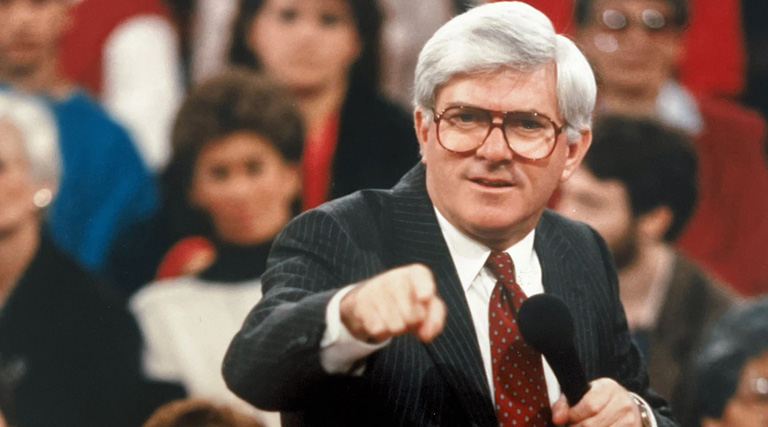
TV’s Phil Donahue will be honored locally with an historical marker
Phil Donahue, the iconic talk show host who revolutionized daytime television, will be honored with a historical marker in the place where it all began.
The city of Moraine will unveil the outdoor marker at an invitation-only ceremony at 9:30 a.m. Sept. 14 at the WDTN-TV studios. The station, formerly WLWD-TV, is being recognized for “the launch of the ‘Phil Donahue Show’ and the birthplace of talk shows featuring audience participation.”
Donahue’s innovative program premiered at 10:30 a.m. Nov. 6, 1967, in Dayton and ended 29 years later in New York City on Sept. 13, 1996.
Donahue’s wife, actress and philanthropist Marlo Thomas, will be a special guest at the event. The couple first met in 1977 in Dayton when Thomas, star of television’s “That Girl” appeared on the show to promote her TV special, “Free to Be You and Me.” They connected on the show again in Chicago and were married 44 years before his death in 2024 at age 88.
WDTN-TV Vice President and General Manager Melissa Jones said the goal is to bring Phil’s story to life by sharing memories, historic photos and a video tribute. In addition to Thomas, speakers will include Ohio Gov. Mike DeWine and Moraine Mayor Teri Murphy. Former employees of the show have been invited, and a tribute wall inside the station is being planned.
The show’s beginning
In the era when the charismatic Donahue first introduced his new program, daytime television consisted mostly of game shows, variety shows and soap operas. Donahue changed that by introducing a wide variety of guests and topics and incorporating feedback and questions from a live studio audience as well as at-home callers. “Is the caller there?” was his trademark query.
Photos: Phil Donahue Show began in Dayton
It was clear from the get-go that this was to be no ordinary program and that daytime television would never be the same. In its first week, Donahue’s guests included outspoken atheist Madalyn Murray O’Hair; a film of the birth of a baby; an anatomically correct male doll without a diaper; and a funeral director who invited Donahue to recline inside a coffin.
“A talk show is a fundamentally democratic event,” Donahue said. “It allows the people who really own the airwaves — the public — to stand up and actually use them. Nobody screens our audience. Nobody tells our audience what to say. This is the street corner.”
“When you look back at the topics Phil was tackling decades ago, it’s remarkable how relevant so many of those conversations still are today,” said Jones. “He wasn’t afraid to take on difficult, sometimes controversial issues and give people a place to talk openly about them. In many ways, some of those conversations might even be considered too provocative for daytime television today. Phil was truly a pioneer. He didn’t just host a talk show, he changed what television could be and how it could bring people into the conversation.”
Photos: The Phil Donahue Show had its start in Dayton
Donahue devoted a whole hour to a single subject, focusing on guests who were experts in a particular field, newsmakers or celebrities. Although the subject matter was often challenging, he was known for being respectful not just to his guests but to his audience members. As they left his studio after a show, he would greet each one: “You look so much better in person!”
After two years in Dayton as a local program, WLWD’s parent company, Avco Broadcasting, began televising “The Phil Donahue Show” on its other Midwest stations. Twelve years later, the show was airing in 200 markets, including Alaska, Hawaii and Puerto Rico, and eventually reached Canada, Australia and England on the Armed Forces Radio and Television Service.
An estimated 1,500 shows were broadcast live from the Dayton studios before the show moved on, first to Chicago in 1974, where the name was changed to “Donahue,” and then to New York’s NBC Studios at Rockefeller Center in 1985.
From its Dayton days, the program would go on the road, originating from remote locations such as the Ohio State Fair. In 1971, Donahue taped a week of shows inside the Ohio State Penitentiary. He made broadcasting history as the first American talk show host to tape inside the Soviet Union, and he was the first Western journalist to visit the Chernobyl nuclear power plant after the accident in 1986.
Donahue_12.jpg
The program earned 20 Emmy Awards, as well as a Peabody Award for Donahue in 1980. President Joe Biden awarded a Presidential Medal of Freedom to Donahue.
Former staffers reminisce
Pat McMillen, who worked on the show from its first day in Dayton until its last day in New York, began as a secretary, warmed up the audience and eventually became the executive producer. She now lives in Dublin, Ohio, and was Donahue’s last guest on his final show.
In those early days, McMillen said, their three-person staff was so busy getting the show on the air, they didn’t have time to realize the ways in which it was changing the television landscape. The staff worked out of a cramped room that had previously been a dressing room for Channel 2’s professional wrestlers.
“Now I appreciate it more and I think of what we accomplished and all the people we met. It was a great learning experience. You couldn’t have a more interesting job. We didn’t think of Phil as our boss; We just all worked together.”
Lorri Antosz Benson, a Centerville High School graduate who worked on special projects for Donahue in Chicago before becoming the show’s senior producer, believes no television show in history has had the impact, depth, breadth or diversity.
“Our show prevented suicides, changed laws, and found a heart for a baby who the medical establishment had abandoned,” Benson said.
“We had in-depth conversations with future presidents and popular icons, as well as the head of the Ku Klux Klan and the American Nazi Party. We had Nelson Mandela on the show, and in the same week, one of the most popular shows, male strippers.”
Benson, who now lives in Santa Monica, California, said anything current was always fair game. She said Donahue had a certain “something,” a relatability that made people feel they could really talk to him.
“We brought diverse opinions together on the same stage. I think that’s what’s missing today, to have a dialogue with people you don’t agree with. We gave the disenfranchised a voice and transformed lives. We were often the first to tackle a difficult or controversial topic, such as the AIDS crisis or the anti-war movement. And Phil Donahue was the brilliant lightning rod leading the charge. There was no one like him then or since.”
Devoted audience member Linda Lewis spoke for millions of loyal viewers when she wrote this following his death:
“Every morning I would get my children up and ready for the day and my neighbor and I would meet for coffee and Phil Donahue. Our children played as we watched and discussed whatever topic Phil had that day. I still think it was the best talk show ever. His light will be missed.”
DDN